
Proportional Vacation: How Does It Work Upon Termination?
Advertisements
To the proportional vacation represent an essential labor right in Brazil, guaranteed by the Consolidation of Labor Laws (CLT) and frequently debated in times of contract termination.
However, its application raises doubts for both employers and workers, especially due to the legal nuances and specific calculations involved.
Therefore, understanding how this benefit is calculated, applied and paid upon termination is crucial to ensuring fairness and transparency in employment relations.
In this article, we will explore in detail and intelligibly how proportional vacation pay upon termination works, with solid arguments, practical examples, relevant statistics, and an analogy to facilitate understanding.
Additionally, we will include informative tables and a frequently asked questions section to enrich the content.
After all, why leave room for uncertainty on such an important topic?
Advertisements
Let's dive into this topic with clarity and depth.
What Are Proportional Vacations and Their Importance in Termination?

Proportional vacations, as provided for in article 146 of the CLT, are the worker's right to receive the amount corresponding to the vacation period not taken, calculated based on the time worked in the year of termination.
Read also: How Pronampe credit works for small businesses
Unlike full vacations, which require 12 full months of work, proportional vacations are due even in short-term contracts or in cases of dismissal.
This ensures that the employee is compensated for any unused rest.
On the other hand, the relevance of this right goes beyond financial compensation.
Proportional vacations reflect the constitutional principle of worker protection, recognizing that rest is a pillar for physical and mental health.
In termination, they function as a balancing mechanism, ensuring that the employee is not harmed by the end of the employment relationship.
However, its correct application depends on a clear understanding of the legal rules, especially in cases of dismissal for just cause, where the right may be suppressed.
Therefore, understanding proportional vacations is essential to avoid labor disputes.
Data from the Superior Labor Court (TST) show that, in 2023, approximately 15% of labor lawsuits in Brazil involved disputes related to severance pay, including proportional vacations.
This statistic reinforces the need for transparency and knowledge on the subject, both for employers who wish to comply with the legislation and for workers seeking to guarantee their rights.
How to Calculate Proportional Vacation upon Termination
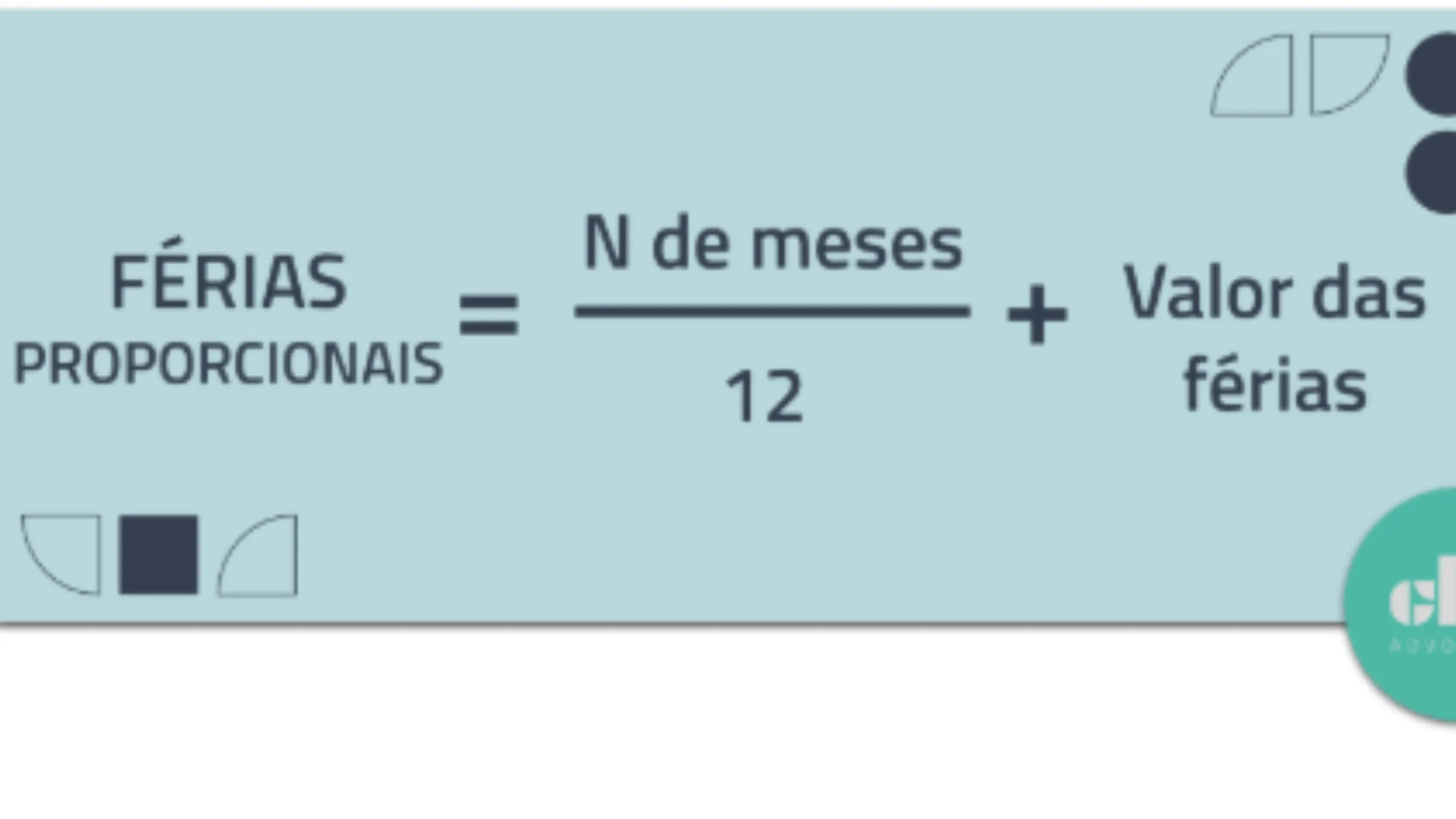
Calculating proportional vacation may seem complex at first glance, but with the correct methodology, the process becomes accessible.
++ How does the IPVA exemption work for people with disabilities?
The calculation considers the time worked in the year of termination, dividing the employee's salary by 12 (months) and multiplying by the number of months worked.
For legal purposes, a month is considered complete if the worker works for at least 15 days in that period.
Furthermore, the constitutional third of vacation pay, provided for in article 7 of the Federal Constitution, must be added to the amount.
To illustrate, imagine an employee with a salary of R$ 3,000 who worked 8 months before termination. The calculation would be: (R$ 3,000 ÷ 12) × 8 = R$ 2,000 (proportional vacation).
Add the constitutional third: R$ 2,000 ÷ 3 = R$ 666.67. The total to be received would be R$ 2,666.67.
This example demonstrates how the calculation is proportional to the length of service, ensuring fair payment.
However, it is important to check if there are any collective agreements that may change the rules, such as additional bonuses.
Finally, it is worth highlighting that the calculation may vary depending on the type of termination.
In the case of dismissals without just cause, proportional vacations are always due, plus the constitutional third.
In cases of just cause, the worker loses this right, according to article 146 of the CLT.
Therefore, mastering these nuances is essential to avoid mistakes that can be costly, whether in fines for the company or losses for the employee.
Table 1: Example of Proportional Vacation Calculation
| Monthly Salary | Months Worked | Proportional Vacation Value | Constitutional Third | Total Receivable |
|---|---|---|---|---|
| R$ 3,000 | 8 | R$ 2,000 | R$ 666.67 | R$ 2,666.67 |
| R$ 2,500 | 6 | R$ 1.250 | R$ 416.67 | R$ 1,666.67 |
Differences in Rules by Type of Termination
The rules for paying proportional vacations vary significantly depending on the type of termination, which requires extra attention.
In the event of an unfair dismissal, the employee is entitled to proportional vacation plus the constitutional third, regardless of the length of service.
++Who is entitled to Prison Assistance and How to Apply Without Making Mistakes
This guarantee reflects the commitment of labor legislation to protect workers in situations of involuntary dismissal.
Furthermore, the company must pay the severance pay within 10 calendar days, in accordance with article 477 of the CLT.
On the other hand, in the case of dismissal for just cause, the scenario changes drastically.
In this case, the employee loses the right to proportional vacation, in addition to other benefits, such as the proportional 13th salary and the 40% fine on the FGTS.
The legal justification is that the just cause arises from a serious infraction by the worker, such as abandonment of employment or an act of misconduct.
However, the application of just cause requires robust evidence from the employer, otherwise the dismissal may be reversed judicially.
When resigning, the employee is also entitled to proportional vacation time, but payment may be impacted by other factors, such as prior notice.
If the employee fails to give notice, the employer may deduct up to one month's salary, which may reduce the final amount of the severance pay.
This dynamic highlights the importance of negotiating clear conditions at the time of termination, avoiding unpleasant surprises for both parties.
Impacts of Proportional Vacations for Companies and Workers

Pro-rata vacations have profound implications for both employers and employees, influencing everything from financial management to workplace satisfaction.
For companies, paying this duty correctly is a matter of legal compliance and reputation.
Errors in calculation or application of the rules can result in fines and labor lawsuits, which, according to the TST, cost Brazilian companies more than R$1,400 million in 2023.
Therefore, investing in qualified HR management is a smart strategy to mitigate risks.
For employees, proportional vacations represent more than just financial value; they symbolize recognition of the effort dedicated to the company.
Receiving this right fairly reinforces trust in institutions and the labor system.
On the other hand, absence or incorrect payment can generate frustration and distrust, even impacting the search for new opportunities in the market.
After all, who doesn't want to work in an environment that respects their rights?
Similarly, proportional vacations can be compared to a car's fuel tank.
The worker “fuels” the company with his effort over time, and proportional vacations are the “fuel” returned so that he can recharge his energy, even if the journey (the contract) is interrupted earlier than planned.
This analogy highlights the importance of balancing the relationship between employer and employee, ensuring that both benefit.
Practical Application Examples
Example 1: Ana, the Salesperson Dismissed Without Just Cause
Ana worked as a saleswoman in a clothing store, earning R$2,200, and was dismissed without just cause after 10 months of contract.
To calculate your proportional vacation, the store divided your salary by 12 (R$ 2,200 ÷ 12 = R$ 183.33) and multiplied it by the 10 months worked (R$ 183.33 × 10 = R$ 1,833.30).
The constitutional third was calculated as R$ 1,833.30 ÷ 3 = R$ 611.10, totaling R$ 2,444.40. Ana received the amount upon her termination, which helped her plan her transition to a new job.
Example 2: Carlos, the Resignation Request
Carlos, an administrative assistant with a salary of R$ 1,800, resigned after 7 months of work.
He was entitled to proportional vacations, calculated as: (R$ 1,800 ÷ 12) × 7 = R$ 1,050. The constitutional third was R$ 1,050 ÷ 3 = R$ 350, totaling R$ 1,400.
However, as Carlos did not serve his notice period, the company deducted R$ 1,800 from the severance pay balance, which significantly reduced the amount received.
This case illustrates the importance of planning the shutdown carefully.
Both examples show how proportional vacations directly impact the employee's financial planning upon termination.
Furthermore, they reinforce the need for employers to follow legal rules to avoid future complications.
Frequently Asked Questions About Proportional Vacations
Below, we present a table with the most common questions about proportional vacation, offering clear and direct answers to clarify recurring doubts.
Table 2: Frequently Asked Questions About Proportional Vacations
| Question | Response |
|---|---|
| Who is entitled to proportional vacation? | All workers with a formal employment contract, except in cases of dismissal for just cause. |
| How are proportional vacations calculated? | Divide the salary by 12 and multiply it by the months worked, adding the constitutional third. |
| What happens if the company does not pay the right? | The company may be fined and taken to court by the worker. |
| Are proportional vacations paid upon resignation? | Yes, with the constitutional third, but discounts such as advance notice may apply. |
| Are temporary contracts entitled to proportional vacations? | Yes, as long as the worker has worked for at least 15 days in the month. |
Conclusion: The Importance of Knowing Your Rights
To the proportional vacation They are more than just severance pay; they represent a fundamental right that reflects the value of work and rest in Brazilian legislation.
Understanding its rules, calculations, and applications is essential to ensuring fairness in labor relations, whether for the employee seeking their rights or for the employer seeking to comply with the law.
Through practical examples, statistics, and analogies, this article demonstrated how this benefit directly impacts the lives of workers and companies.
Therefore, the question remains: why let such an important right be neglected due to lack of information?
Invest in knowledge and transparency to build fairer and more balanced labor relations.
After all, respect for labor rights is the basis for a healthy and sustainable labor market.
